
Normal Ear Functions
Hearing plays an important role in daily life. From alarms to conversations, it allows us to receive and share information. The auditory system is complex and depends on several steps working correctly.
Steps of Hearing:
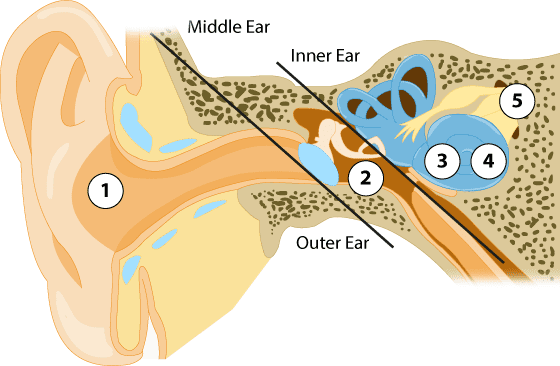
- Sound travels through the air as sound waves. These waves are collected by the outer ear and guided through the ear canal to the eardrum.
- The sound waves cause the eardrum to vibrate, which moves the three small bones in the middle ear.
- These bones pass the vibrations into the fluid of the inner ear, also known as the cochlea.
- The movement of the fluid causes hair cells in the cochlea to bend. These cells convert the movement into electrical signals.
- The electrical signals travel along the auditory nerve to the brain, where they are interpreted as sound.
The Outer Ear
The visible part of the outer ear is called the pinna, or auricle. Its shape, along with the ear canal, naturally boosts sound in the 2000 to 3000 Hz range. This range includes many consonant sounds in speech.
The ear canal, also known as the external auditory meatus, is the second main part of the outer ear. It is lined with thin skin and fine hairs and has a strong blood supply. Earwax, or cerumen, forms in the canal and helps protect the skin from bacteria and moisture. Earwax is normal and varies from person to person. It only becomes an issue if it fully blocks the ear canal.
The Middle Ear
The eardrum, or tympanic membrane, separates the outer and middle ear. Although very thin, it has three layers that give it strength.
The ossicles are three small bones located behind the eardrum. They form a connected chain that carries vibrations from the eardrum. These bones increase the strength of the vibrations and pass them into the inner ear.
The Eustachian tube helps balance air pressure in the middle ear. The middle ear is enclosed in bone and only connects to outside air through this tube. It is usually closed but opens during swallowing, yawning, or chewing. It can also open during pressure changes, such as flying, which may cause a popping sound.
The Inner Ear
The inner ear is located deep in the temporal bone on both sides of the head. It contains two main structures: the semicircular canals and the cochlea.
The semicircular canals are not involved in hearing. They help maintain balance during movement. The cochlea is the main hearing organ. It is a fluid-filled, snail-shaped structure that converts vibrations from the middle ear into electrical signals.
Inside the cochlea, hair cells bend as fluid moves in response to vibration. This movement creates electrical signals that travel through the auditory nerve to the brain. The cochlea is organized by frequency, similar to a piano, and processes sounds from about 20 Hz to 20,000 Hz in humans.